Sunday, December 9, 2012

"Numina" - Masks for the Elemental Powers

Drought

My  Numina Masks  invite others to join in the great "Mythic Conversation" with the Spirits of Place through storytelling and masks.  In 2013 the collection was used by playwright and activist Ann Waters, along with her collaborator Mana Youngbear and extraordinary community to produce
"The Awakening:  Our Changing Earth" in California.

Below is an article I wrote about "Numina", and  renewing our conversation with the Earth.

I think it's time to learn to listen........

Numina: Spirit of Place, Myth and Pilgrimage

by Lauren Raine MFA

From Coreopsis Magazine (2014) 

“To the native Irish, the literal representation of the country was less important than its poetic dimension. In traditional Bardic culture, the terrain was studied, discussed, and referenced: every place had its legend and its own identity….what endured was the mythic landscape.”   

 R.F. Foster, (2001, p. 130)
The Romans believed that special places were inhabited by intelligences they called Numina, the “genius loci” of a particular place. I personally believe many mythologies may be rooted in the experience of “spirit of place”, the numinous, felt presence within a sacred landscape.
To early and indigenous peoples, nature includes a “mythic conversation”, a conversation within which human beings participate in various ways. Myth is, and always has been, a way for human beings to become intimate and conversant with what is vast, deep, and ultimately mysterious. Mything place provides a language wherein the “conversation” can be spoken and interpreted, and personified. Our experience changes when Place becomes “you” or “Thou” instead of “it”.

In the past, “Nature” was not just a “resource”; the natural world was a relationship within which human cultures were profoundly embedded. The gods and goddesses arose from the powers of place, from the powers of wind, earth, fire and water, as well as the mysteries of birth and death. In India, virtually all rivers bear the name of a Goddess. In southwestern U.S., the “mountain gods” dwell at the tops of mountains like, near Tucson, Arizona, Baboquivari, sacred mountain to the Tohono O’odam, who still make pilgrimages there and will not allow visitors without tribal permission. This has been a universal human quest, whether we speak of the Celtic peoples with their legends of the Fey, ubiquitous mythologies of the Americas, or the agrarian roots of Rome: the landscape was once populated with intelligences that became personified through the evolution of local mythologies.


The early agrarian Romans called these forces “Numina”. Every river, cave or mountain had its unique quality and force – its inherent Numen. Cooperation and respect for the Numina was essential for well-being. And some places were places of special potency, such as a healing spring or a sacred grove.   As monotheistic religions developed, divinity was increasingly removed from nature, and the natural world lost its “personae”. In the wake of renunciate religions that de-sacralized nature and the body, and then the rapid rise of industrialization, nature has become viewed as something to use or exploit, rather than a relationship with powers that require both communion and reciprocity. Yet early cultures throughout the world believed that nature is alive, intelligent, and responsive, and they symbolized this through local mythologies. From Hopi Katchinas to the Orisha of Western Africa, from the Undines of the Danube to the Songlines of the native Australians, from Alchemy’s Anima Mundi, every local myth reflects what the Romans knew as the resident “spirit of place”, the Genius Loci.

Contemporary Gaia Theory revolutionized earth science in the 1970’s by proposing that the Earth is a living, self-regulating organism, interdependent and continually evolving in its diversity.
The Gaia Hypothesis, which is named after the Greek Goddess Gaia, was formulated by the scientist James Lovelock and co-developed by the microbiologist Lynn Margulis in the 1970s. While early versions of the hypothesis were criticized for being teleological and contradicting principles of natural selection, later refinements have resulted in ideas highlighted by the Gaia Hypothesis being used in subjects such as geophysiology, Earth system science, biogeochemistry, systems ecology, and climate science. …………….In some versions of Gaia philosophy, all life forms are considered part of one single living planetary being called Gaia. In this view, the atmosphere, the seas and the terrestrial crust would be results of interventions carried out by Gaia through the coevolving diversity of living organisms.

If one is sympathetic to Gaia Theory, it might follow that everything has the potential to be responsive in some way, because we inhabit and interact with a vast living ecological system, whether visible to us or not. Sacred places may be quite literally places where the potential for “interaction” is more potent. There is evidence that Delphi was a sacred site to prehistoric peoples prior to the evolution of Greece. Ancient Greeks built their Temple at Delphi because it was a site felt to be particularly auspicious for communion with the Goddess Gaia. Later Gaia was displaced by Apollo, who also became the patron of Delphi and the prophetic Oracle. Mecca was a pilgrimage site long before the evolution of Islam, and it is well known that early Christians built churches on existing pagan sacred sites.

There is a geo-magnetic energy felt at special places that can change consciousness. Before they became contained by churches, standing stones, or religious symbolism, these “vortexes” were intrinsically places of numinous power and presence in their own right.

Roman philosopher Annaeus Seneca junior commented that:


"If you have come upon a grove that is thick with ancient trees which rise far above their usual height and block the view of the sky with their cover of intertwining branches, then the loftiness of the forest and the seclusion of the place and the wonder of the unbroken shade in the midst of open space will create in you a feeling of a divine presence, a Numen."


Personal Encounters

Many years ago I lived in Vermont, and one morning I went down to the local Inn for a cup of coffee to discover a group of people about to visit one of Vermont’s mysterious stone cairns on Putney Mountain, the subject of a popular book by Barry Fell, a Harvard researcher, and under continual exploration by the New England Archeological Research Association (NEARA). I had stumbled upon their yearly Conference. Among them was Sig Lonegren , a well-known dowser and researcher of earth mysteries who now lives in Glastonbury, England and was then teaching at Goddard College in Vermont. Through his spontaneous generosity, I found myself on a bus that took us to a chamber constructed of huge stones, hidden among brilliant foliage, with an entrance way perfectly framing the Summer Solstice.

Fell and others suggest that Celtic colonists built these structures, which are very similar to cairns and Calendar sites found in Britain and Ireland; others maintain they were created by a prehistoric Native American civilization, but no one knows for sure who built them. They occur by the hundreds up and down the Connecticut River. Approaching the site on the side of Putney Mountain, I felt such a rush of vitality it took my breath away. I was stunned when Sig placed divining rods in my hands, and I watched them open as we traced the “ley lines” that ran into this site. Standing on the huge top stone of that submerged chamber, my divining rod “helicoptered”, letting me know, according to Sig, that this was the “crossing of two leys”; a potent place geomantically.
“Approaching the site on the side of Putney Mountain, I felt such such a rush of vitality it took my breath away. I was stunned into silence when Sig placed divining rods in my hands, and I watch them open as we traced the ‘ley lines’…

According to many contemporary dowsers, telluric energy moves through stone and soil, strongest where water flows beneath the earth, such as in springs, and also where there is dense green life, such as an old growth forest. Telluric force is affected by planetary cycles, season, the moon, the sun, and the underground landscape of water, soil and stone. Symbolically this “serpentine energy” has often been represented by snakes or dragons. “Leys” are believed to be lines of energy, not unlike Terrestrial acupuncture lines and nodes, that are especially potent where they intersect, hence dowsers in Southern England, for example, talk about the “Michael Line” and the “Mary Line”, which intersect at the sites of many prehistoric megaliths, as well as where a number of Cathedrals were built.

At the time I knew little about dowsing, but I was so impressed with my experience that months later I gathered with friends to sit in the dark in that chamber, while we watched the summer Solstice sun rise through its entrance. We all felt the deep, vibrant energy there, and awe as the sun rose to illuminate the chamber, we all left in a heightened state of awareness and empathy.

Earth mysteries researcher John Steele wrote in EARTHMIND, a 1989 book written in collaboration with Paul Deveraux and David Kubrin, that we suffer from what he called “geomantic amnesia”. We have forgotten how to “listen to the Earth”, lost the capacity to engage in what he termed “geomantic reciprocity”. Instinctively, mythically, and practically, we have lost the sensory and imaginative communion with place and nature that informed our ancestors spiritual and practical lives, to our great loss.

We diminish or destroy, for money, places of power long revered by generations past, oblivious to the unique properties it may have, and conversely, build homes, even hospitals, on places that are geomagnetically toxic instead of intrinsically auspicious. Our culture, versed in a “dominator” and economic value system, is utterly ignorant of the significance of place that was of vital importance to peoples of the past. Re-discovering what it was that inspired traditional peoples to decide on a particular place for healing or worship may be important not only to contemporary pilgrims, but to a way of seeing the world we need to regain if we are to continue into the future as human culture at all.

Making a pilgrimage to commune in some way with a sacred place is a something human beings have been doing since the most primal times. Recently unearthed temples in Turkey’s Gobekli Tepe reveal a vast ceremonial pilgrimage site that may be 12,000 years old. The Eleusinian Mysteries of Greece combined spirit of place and mythic enactment to transform pilgrims for over two millennia.
One of the most famous contemporary pilgrimages is the “Camino” throughout Spain, which concludes at the Cathedral of Santiago at Compostella. Compostella comes from the same linguistic root as “compost”, the fertile soil created from rotting organic matter – the “dark matter” to which everything living returns, and is continually resurrected by the processes of nature into new life, new form. Pilgrims arriving after their long journey are being metaphorically ‘composted’, made new again. When they emerge from the darkness of the medieval cathedral in Compostella, and from the mythos of their journey, they were ready to return home with their spirits reborn.]

In 2011 I visited the ancient pilgrimage site of Glastonbury, England. Glastonbury’s ruined Cathedral once drew thousands of Catholic pilgrims, and Glastonbury is also Avalon, the origin of the Arthurian legends, a prehistoric pilgrimage site. To this day thousands still travel to Glastonbury for the festivals held there, and for numerous metaphysical conferences, including the Goddess Conference I attended. The sacred springs of the Chalice Well and the White Spring have been drawing pilgrims since long before recorded history, and many people come still to drink their waters.
Making this intentional Pilgrimage left me with a profound, very personal sense of the “Spirit of Place”, what some call the “Lady of Avalon” and taking some of the waters from the Holy Springs back with is ever a reminder of the dreams, synchronicities and insights I had there.

Sacred Sites are able to raise energy because they are geomantically potent, and they also become potent because of human interaction. “Mythic mind”, the capacity to interpret and interact with self, others and place in symbolic terms (as, for example, the way the Lakota interpret “vision quest” experiences) further facilitates the communion. Sig Lonegren, who is one of the Trustees of the Chalice Well in Glastonbury, and a famous dowser, has speculated that as human culture and language became increasingly complex, verbal, and abstract, we began to lose mediumistic, empathic consciousness, a daily intuitive gnosis with the “subtle realms” that was further facilitated by ritual. Dowsing is a good example of daily gnosis. “Knowing” where water is something many people can do without having any idea of how they do it. Sometimes, beginning dowsers don’t even need to “believe” in dowsing in order to, nevertheless, locate water with a divining rod.

With the gradual ascendancy of left-brained reasoning, and with the development of patriarchal religions, he suggests that tribal and individual gnosis was gradually replaced by complex institutions that rendered spiritual authority to priests who were viewed as the sole representatives of God. The “conversation” stopped, and the language to continue became obscured or lost.

Perhaps this empathic, symbolic, mediumistic capacity is returning to us now as a new evolutionary balance, facilitated by re-inventing and re-discovering mythic pathways to the Numina.


References:


Foster, R.F.(2001) , The Irish Story: Telling Tales and Making It Up in Ireland (London: Allen
Lane/Penguin Press), page 130.
Lovelock, J. and Margulis, L., (1970) The Gaia Hypothesis, quote is from Wikipedia
Retrieved on: May 11, 2014 http://en.wikipedia.org/wiki/Gaia_hypothesis
Seneca, L. Annaeus junior (65 A.D.) Epistulae Morales at Lucilium, 41.3.
Retrieved on: Wikipedia http://en.wikipedia.org/wiki/Epistulae_morales_ad_Lucilium
Fell, B. (1976, 2013). America B.C.: Ancient Settlers in the New World, Artisan Publishers, N.Y.
Lonegren, S. (2013) Mid Atlantic Geomancy, Blog. Retrieved on: http://www.geomancy.org/
Steele, J. (1989). Earthmind: Communicating with the living world of Gaia, with Paul Devereaux
and David Kubrin. Harper and Row: N.Y. Page 157.

Thursday, September 13, 2012

Orange Nights - Show in Riudoso

"Fire" Lauren Raine (2012)


ORANGE NIGHTS
 A COMMUNAL GATHERING OF HEALING EXPRESSIONS
Ruidoso, New Mexico  

Saturday, April 2, 2011

Working with Masks

THE  TRANSFORMATIVE  MASK
Working with Masks and  Myth
Patricia Ballentine with mask she made at 2016 Workshop

"Our work was not to re-enact the ancient myths, but to take those myths to their
 next level of evolutionary unfolding. Artists are the myth makers."
                    Katherine Josten,  Founder,  THE GLOBAL ART PROJECT

Every mask is the beginning of a story, because each mask is inhabited by a being waiting to reveal itself, whether a universally recognizable archetype, or an eccentric,  very personal inner persona that can communicate in surprising ways.  Masks can heal by speaking with a voice that we can't, and masks can provide an opportunity for transpersonal experience as well, when we engage with sacred and universal archetypes.   In traditional cultures, such as Bali, sacred masks were viewed as a means for the divine - the gods, goddesses, ancestors and animal powers - to bless the living through ritual theatre.


Making a mask is a process, but it's only part of the process - those who will use the mask complete the journey.  And because the "spirits of the masks" come from the Mythic Realm, there is really no end to the journey at all.  Just a circle of new telling.


In my workshops, we learn to sculpt a theatrical mask from our faces, explore personally significant stories and symbols, and learn approaches to storytelling with masks, with discussion about community performance and ritual theatre.  I've found it's best to "invite the spirit of the mask" by beginning with a shared "Shrine".  Participants  bring objects that are personally  sacred and meaningful.  Our "Invocation" is sometimes a creative visualization exercise.    After we've created a "Circle" to work in, we "get plastered" in pairs as we take casts of our faces with plaster impregnated bandages. These will become plaster positives on which more durable leather masks can be then modelled.   Plaster  casts can also be used to create masks and sculpture from clay and other media.  See below for a few examples from other students.

Preparing materials


Taking Face cast

Ready to remove


Casts of class members, Kripalu Institute
Modelling and shaping mask with Leather
  
Embellishing
(Courtesy Nancy Solomon)
Finished Wearable Leather Mask
(courtesy Barbara Gregson)

Cast in Clay made into Personal Icon
(courtesy Lorraine LeConte)


Leather sculpture with Torso cast

Monday, February 14, 2011

The Masks of the Goddess Project


"Bridgit" (Linda Johnson) - Irish Goddess of Inspiration and Healing.  Photo is courtesy Thomas Lux.
 I've always been fascinated with masks in traditional societies,  where they are viewed as    “vessels for the archetypal powers”.  With a mask, the Gods and Goddesses, the Animal Powers, can visit for a while, tell their stories, give their blessings, heal or even give prophecy, and they are considered powerful magical tools.  In Bali, for example, special "Temple Masks" are kept in the Temple, and carefully treated with holy water before and after each sacred performance.

In 1999, after going to Bali myself to study mask arts, I created 30 masks of multi-cultural Goddesses, derived from mythologies around the world. Inspired by Balinese sacred masks, I wanted to offer my own collection as contemporary "Temple Masks", devoted to celebrating, exploring, telling and performing some of the great universal myths of the   Divine Feminine. 
"Sophia" (Valerie James)

Masks have so much transformative power.  The Masks of the Goddesses were created to  re-tell and re-new these important universal stories, as well as empowering the women who "invoke" a Goddess to explore each archetypal presence within herself. What does the story of Sedna, ocean mother of the Inuit,  have to teach us about balance and ecology?  What is the "Mirror of Sophia", goddess of wisdom?  How is the "Descent of Inanna" a potent story of psychological death and rebirth?  

I, and colleagues Macha NightMare, Diane Darling, Mana Youngbear, Serene Zloof, Lilla Luoma, and others,  produced community performances and taught workshops with the collection, making  The Masks of the Goddess available nationally.  The result was that they traveled throughout the U.S.  In 2008 the collection was retired, and sold through a Benefit auction.

In 2012 I began a new series of sacred masks I call "Numina", which are now available to communities for their use.  The Romans believed nature was inhabited by elemental forces they called Numina, and many Roman sites  had little shrines dedicated to  the "genius loci" of a particular place. We cannot live as early Romans, or indigenous people have,  but we can re-invent a “mythic dialogue” with the  elemental powers of nature  through storytelling, invocation, and the use of masks.   It is my hope this new collection will travel as extensively as the earlier collection.

Medicine Basket - "Gather and Offer"


Gaea

"The masks of the goddess workshop was a pivotal event in my life. I have been feeling the Goddesses waking up ever since.....they were there, definitely there."
Lorraine Hogan, Kripalu Institute (2007)
 
"Our group's work was not to just tell the ancient myths, but to re-invent them for today.  Artists are the myth makers."

Katherine Josten, The Global Art Project (2004)
"What the audience saw when a dancer looked through the eyes of the mask was the Goddess herself, ancient and yet  contemporary,  looking across time, across the miles."


Diane Darling, Director, Playwright, 2001

"Spider Woman" (Morgana Canady) weaving.  Photo courtesy Annie Beam.
"Myth comes alive as it enters the cauldron of evolution, itself drawing energy from the storytellers who shape it."


  Elizabeth Fuller,  The Independent Eye , 2002
"The Virgin of Guadalupe" (Valerie James).  Photo courtesy Ileya Stewart.
Comments about  The Goddesses, by participants in the Project  (2000 - 2005):

"Kali is so much about contemporary life.  The demons of insatiable greed are devouring our planet again. We need to call upon the spirit of Kali, because those who await the future are being denied their birthright. Kali is the catalyst for saying "No more".  It's time to embrace the sword of Kali and cut away the delusions that are destroying our world.........Drissana Devananda

"Pele to me is about the great elemental builders of our planet. Long before people walked upon any lands, the Creatrix of Kilauea brought forth islands from the Earth's hot, molten core, slowly cooling through the ages.  Human beings are recent arrivals, and the fires of Pele burn through  the eons,  stirring up the Pacific, and shaping our very atmosphere."......... Karina McAbee

"Corn Mother's story is about the wealth that comes from the hard work of forgiveness.  How can we be fed, feed each other, how can we create peace, if we cannot learn the lessons of forgiveness?  That is the beginning place we will need in order to evolve into a Rainbow Nation. To me, the Rainbow as actually a circle.  Half the rainbow disappears into the ground, into an underworld realm, where it exists beneath the Earth, dark and hidden, but at the foundation never the less.  Like the Corn Mother."......... Christy Salo

"Lilith rules the liminal landscape between the subconscious and the conscious mind, and can help make that information conscious and usable in your life.  Lilith is the bridge, and "What you believe" is just a shell that keeps you imprisoned.   Lilith is about breaking the shell, because sometimes you have to fall apart to be put back together, that's the only way to be re-integrated."......... David Jeffers

"I remember lighting a candle to symbolize my commitment to my journey through the despair I felt at menopause.  That's Hecate to me.  She will not help you to avoid a thing, but She will bear a light for you on the path, which is really the path to mature empowerment."........Damira Norris

 "Persephone's myth is about moving into a new state of being.  All the soul riches, the knowledge, the art, everything was running down the drain into Hades and it stayed there.  It stopped circulating.  This was the myth of the descent of Inanna as well; everything went down to Ereshkigal, the keeper of the Underworld, and got stuck there in the universal unconscious which could be said of our collective predicament today.  We can see that they are pathfinders to the unconscious.  That's a very important myth for our time." ........Elizabeth Fuller


"Selu" (Kathy Huhtaluta)
The collection appeared at:

The University of Creation Spirituality,   the Chapel of the Sacred Mirrors,  the University of Syracuse Matrilineage Festival, the Health and Harmony Festival, Nations Hall Theatre at the Muse Community Arts Center,  the New College of California,  Sebastopol Community Center, the Masks Symposium at Southern Illinois University,  and the Spiral Dance (1999, and 2006) in San Francisco, and other venues.
At "The Spiral Dance" (2006) Courtesy the San Francisco Chronicle
Thank you to all those who brought the stories, from Aphrodite to the Virgin of Guadaloupe, to many  audiences with the masks.  With special thanks to Macha NightMareMana Youngbear, and Abbie Willowroot, for their collaboration and encouragement.  And to:

Serene Zloof, Annie Bridgit Weller, Diane Darling, Barbara Jaspersen, Starhawk,  Shelly McHugh "Valley High", David Jeffers & Benad Hasche, Monika Mann, Kelly Nelson, Flynt Garner, Silk, Duncan Cook, Celestine Star, Evelie Posche, Lilla Luoma, Will Clipman, Jeff Grienke, Isobel Amourous, Kathy Huataluhta, Ileya Stewart, Morgana Canady, Valerie James, Quynn Elizabeth, Katherine Josten, Erica Swadley, Grey Eagle, Ann Huggins, Celestine Star, Kala, Eleni, Alan Moore, Drissana Devananda, Elizabeth Fuller, Conrad Bishop, Ann Beam, Paloma Hill, Jim Hewes, Arjuna & Tuva Space, Jo Odessa & Buka Creati, Deborah Scott Gren, Mary Kay Landon,  Sabina Magliocco, Farida Fox, Tara Webster, Willow Kelly, Dawn Marlowe, Juan Pablo Guiterrez, Kala Levin, Amadae, Vibra Willow,  Amy Luna Manderino,  James Lovette-Black, Amie Miller,  July Lewis, Stacy Kalkowski, Lee Hendrickson, Adrienne Hirt, Barbara BBC,  Freya Anderson, Morgaine Harris, Laura Janesdaughter, Tansy Brooks, Willow Kelly, Damira Norris, Maria Wahlstrom, Fontain and FONTAIN'S MUSE, Kendra, Copper Persephone, Eleni Livitsanos, Jamra, Cypress, Cris Ferreira,  Christy Salo, Melusina Gomez, Maritza Schaefer, Journey, Nada Khodlova, Stessa, Angela Blessing, Rachel Morgain, Catlin & Reggie Williams, Ingrid Aspomatis, Annie and Phil, Carlin Diamond, Alan & Audrey Smith, Lea Bender, THE VEIL, Sammi Alijagic, Paul Fisher, Toker Johnston, Linda Johnston, Motherbear Scott,  Ashley Wallace, Melissa Penn, Laura Dubois, Dorit Bat Shalom, Jeanne Koelle, Karina McAbee, Navaab Munirith, Charlie Adams, Sharon Kihara, Nettie, Corinne Levy, Judy Foster, Dina, Amanda Allison, Wendy Cornelius,  Kendra Stone, Bombshell Betty, Heaven, Ariel, Shanel, Carrie Adams, Kim Arnold, Nadirah Adeye, Thallia Bird, April Taylor, Donna Peck, Dailey Little, Rhonda, Marisa Scirocco, Jonette Ford, Lyndzee Dava, Ayelen Liberona, Carolyn Lucento, Pythia and the Temple of the Goddess …………and many more.

And thanks again to Thomas Lux, Peter Hughes, Ann Beam, and Ileya Stewart for the generous use of their photographs.
Mana Youngbear as "White Tara" (photo courtesy Ileya Stewart)

Saturday, January 29, 2011

The Hidden Sea

"The Hidden Sea" (2010)

Time does funny things in the desert.....sometimes it reveals an entire ocean, it's frozen tide pools and fossilized sea creatures, below, ebbing for a moment, it's currents waxing within the imagination.   I am always impressed by the notion that I walk on the bed of an ancient ocean, the dreams of our ancestors, just beneath our feet, silently touching our lives.

"Ancestral Midwives" (2005)

Saturday, August 21, 2010

Spider Woman's Hands - second edition published!


"What might we see, how might we live if we saw with a webbed vision?  The world seen through a web of relationships - as delicate as spider’s silk, yet strong enough to hang a bridge on."

Catherine Keller, "From a Broken Web" (1989)


I finally finished my second edition  of my limited edition  book  SPIDER WOMAN'S HANDS - Weaving a Webbed Vision.     

In indigenous cultures, cultures with oral traditions, stories don't end after two hours in a theater, or when we turn off the electronic box. Even today, when we talk about “spinning a good tale“, like the hands of Spider Woman, we’re participating in something that keeps spinning and evolving, generation into generation, from the waking world to the dreamtime, back into the past, and forward into the stories of those who are yet to come. In various native arts, a spider and womb motif is ubiquitous: because Spider was the first weaver, bringing order and form, balance and symmetry to primal, formless chaos from within herself. From her essence she spun the strands that became the first stories that became the world.  

The Navajo ( Dine`) revere Spider Woman (Na'ashje'ii sdfzq'q) for teaching them how to weave. To this day, an infant Navajo girl will have a bit of spider web rubbed into the palms of her hands so she will become a good weaver. Wool rugs often have “Spider Woman's Cross” woven into the pattern, representing balance, the gestalt of the four directions. Navajo weavers also often leave a flaw in the work - because the only perfect web is that of Grandmother Spider Woman. 

" The new myth coming into being through the triple influence of quantum physics, depth psychology and ecology suggests that we are participants in a great cosmic web of life, each one of us indissolubly connected with all others through that invisible field. It is the most insidious of illusions to think that we can achieve a position of dominance in relation to nature, life or each other. In our essence, we are one."


"May we all rub a bit of spider web into the palms of our hands".


Saturday, November 21, 2009

"Weavers" at Wesley Theological, 2009


What might we see, how might we act, if we saw with a webbed vision?"

Catherine Keller, "From a Broken Web"

"What is the new mythology to be, the mythology
of this unified earth as of one harmonious being?"

Joseph Campbell

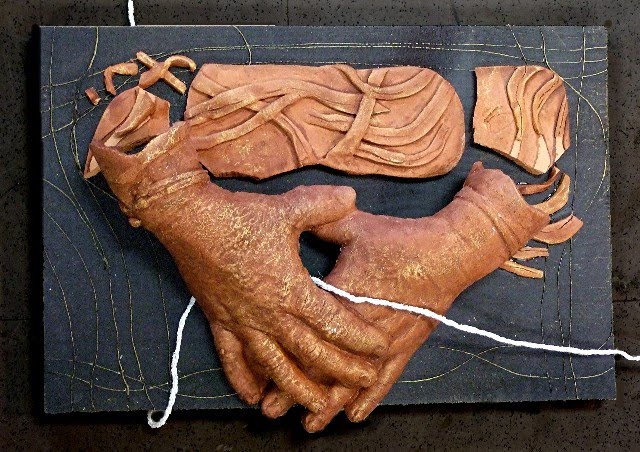
"Weaver's" is installed in the staircase entryway at Wesley. As I worked, the "story" of this progression of hands became clearer to me. It is dedicated to the ongoing collaboration of the community of the Luce Center - for me, it is also a new “telling” of the Spider Woman, the weaver deity found throughout Native American mythology.


"It’s said that all stories
originate in the mind
of Spider Woman."

The "Hand and Eye" is the hand of the Divine, from which all inspirations come. Because it's also about the evolution of the arts center at Wesley, the first pair of hands belong to Cathy Kapikian, who retired this year after founding the program more than 25 years ago.


"The Seed Planter" seemed a fitting progression because all inceptions need visionary collaborators, people who find the means to "ground it into the soil."  Tiles are based on stories told me by those who volunteered their hands. Mr.Tortorici told me that his family came from a village famous for growing olives, and so I made an olive branch. Ms. Oden, who is the Dean, told me she missed the wild storms of her Great Plains homeland, and so I inscribed a storm on her panel.

Dr. Hopkins is an archaeologist who has spent years in the holy lands, so his panel has pottery shards. Mr. Soulen is a banjo player and a bee keeper, which is why I put a flower on the neck of his instrument. The harmonies of music, and honey, sweeten the mix.

Doug Purnell is a painter, providing the hands of the artist. Olaf, who is from Iceland (thus, the "Cod Shield") makes her art from fabric. And Amy Gray brought the Gardener's graceful hands, offering the "flowering" of an idea.

Finally, I included the hands of Colleen Nelson, who has been a community activist all of her life.

Next to last, those of Deborah Sokolove, the new Director of the Luce Center. Deborah says of her Iconic artwork that they are "prayers made visible", and so I titled her panel (she made her own tiles) the "Iconographer".


I grew up with a Native American painting, that belonged to my father, of horses running across a desert. One of the horses was turquoise blue. When I assembled my panels, I found I had an "extra hand" from the cast of a child. I remembered that painting, and how the artist used the blue horse to show the presence of Spirit. So the last panel is for those who are not yet born.
"The new myth coming into being through the triple influence of quantum physics, depth psychology and the ecological movement suggests that we are participants in a great cosmic web of life, each one of us indissolubly connected with all others through that invisible field. It is the most insidious of illusions to think that we can achieve a position of dominance in relation to nature, life or each other. In our essence, we are one."

Anne BaringTo view my:   BIO